
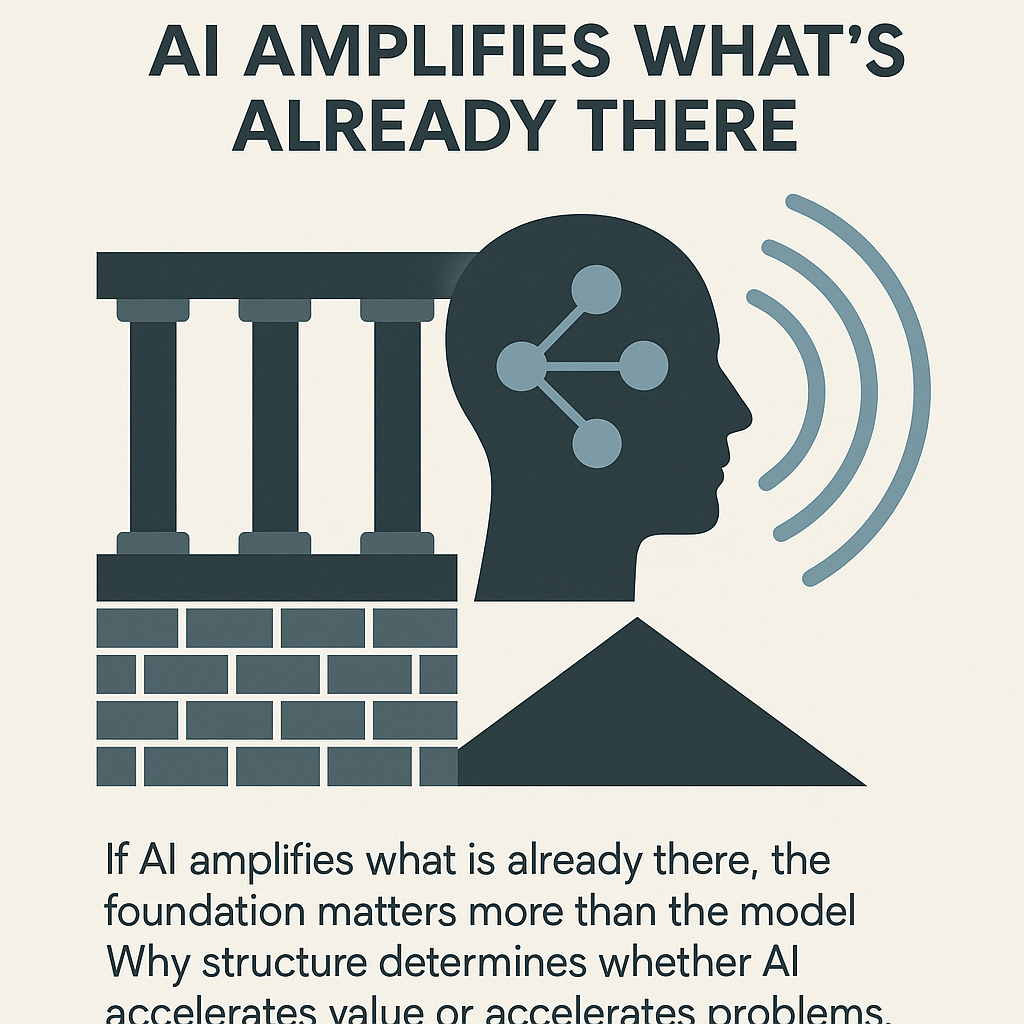
AI Amplifies What's Already There
If AI amplifies what is already there, the foundation matters more than the model. Why structure determines whether AI accelerates value or accelerates problems.
- By
- Anders Bendtsen, Principal Architect & CTO at Consid Denmark
- Published
- February 2026
Two responses to the same shift.
The 2025 DORA report confirms it: organizations adopting AI are seeing faster shipping and more instability. Not one or the other. Both. The speed is real. So is the fragility it exposes.
- Path One — Tool User
Adopt AI within your existing model. Output increases. But the value proposition stays the same. Speed without a change in how you work is still just speed.
- Path Two — Solution Provider
Restructure how work is coordinated, how knowledge accumulates, and how delivery is governed — with AI as a core operating principle. The unit of value shifts from hours to outcomes.
The difference isn't which AI tools you adopt. It's whether you change how you work.
Five principles for staying above the algorithm.
The discipline of staying above the algorithm — not by using AI less, but by ensuring that human direction governs how AI operates.
- 1Think Before You Act
Deliberate intent precedes every action at every level of the work.
- 2Make Intention Explicit
Thinking that is not written down is invisible — to AI and to the team.
- 3Make Knowledge Operational
Skills, playbooks, and structured documentation become the shared source of truth.
- 4Humans Take Critical Decisions
Human judgment is embedded at the right points, not bolted on at the end.
- 5Small Reversible Steps
Execute in discrete, reviewable increments that limit the cost of error.
None of this requires new tools or new platforms. It lives in structured documents in your repository. What it does require is discipline, applied consistently, from the start.
AI doesn't fix fragmentation. It amplifies it.
In most organisations, architecture knowledge is distributed across a handful of people. When those people leave, the knowledge fragments further. Decisions get made twice because no one recorded the first one.
When AI enters this environment, it doesn't resolve the fragmentation. It operates on top of it — amplifying the gaps already present. The EA Workbench makes the landscape answerable: mapping what exists, how systems connect, and where decisions have been made and why.
Three layers of the practice.
- 1Landscape and Governance
Establish a structured architecture practice from the top floor. Landscape mapped, decisions governed, compliance visible. You leave with a catalog you own and a governance model you operate.
- 2Architecture Foundation
For a specific initiative: architecture-driven and spec-driven from day one. Structured descriptions, living decision records, specifications that AI agents and developers can build from with confidence.
- 3Directed Agentic Delivery
Skills, playbooks, opinionated documentation structure, specification tooling, human approval gates. We work alongside the team until the way of working is theirs.
Frequently asked
- What does it mean that AI amplifies what is already there?
- AI accelerates whatever foundation it sits on. If the architecture is clear and the specifications are honest, AI accelerates value. If the foundation is muddled, AI accelerates the existing problems faster than humans can correct them.
- Where should organisations start?
- Start by improving the foundation: architectural clarity, specification discipline, and decision traceability. AI capability layered on top of that compounds; layered on top of ambiguity, it amplifies risk.
Two leaders. An open and honest conversation.
Michael Lund-Andersen and Anders Bendtsen are available for a direct conversation about what agentic delivery means for your organisation.