
Map Your Application
Before you build on it, understand what you have. We map your application — components, dependencies, data flows, and decision history.
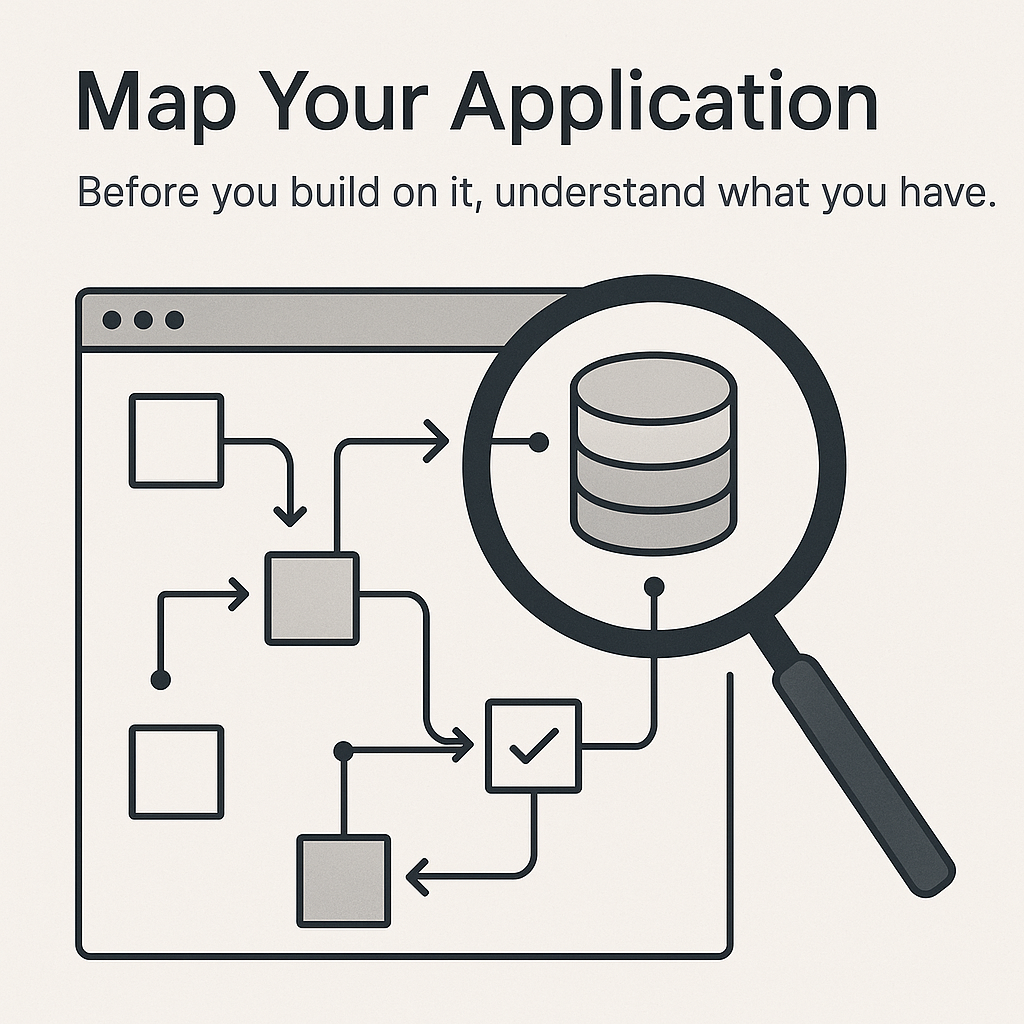
An accurate picture of what is actually running.
Before you refactor, modernise, or build on top of an existing application, you need to understand it. Most teams inherit codebases with incomplete documentation, undocumented decisions, and unclear boundaries. Map Your Application gives you that clarity.
This is a short, focused engagement — typically two to four weeks — that produces an accurate architectural picture of a single application or bounded system.
- Typical duration
- 2–4w
- Deliverables
- 4
- Application in scope
- 1
We read the code. We talk to the people. We document what is actually there.
- Components
We identify the logical components, their responsibilities, and their boundaries. Not what the diagram says — what the code says.
- Dependencies
We map internal and external dependencies: what the application calls, what calls it, and where the coupling is tight.
- Data flows
We trace how data moves through the system — inputs, transformations, storage, outputs.
- Decision history
Where we can find it, we capture the decisions that shaped the architecture. Why is it structured this way? What was tried and discarded? This context is what teams lose when people leave.
A catalog you can act from.
- 1Component catalog
The logical structure of the application, with responsibilities and boundaries.
- 2Dependency map
Internal and external. Where the coupling is tight. Where the risk lives.
- 3Data flow diagram
How data moves through the system from input to storage to output.
- 4ADR register
Recovered architectural decisions. The context your team needs to make the next ones well.
- 5Gap list
What is unclear, what is risky, what needs a decision before you can safely move forward.
Teams that need to understand before they build.
Teams taking over an existing application, planning a modernisation programme, or preparing to introduce AI-assisted delivery into a codebase they do not fully understand yet.
Frequently asked
- What does mapping an application produce?
- A structured description of your application — components, data, integrations, and the decisions behind them — captured as living specifications you can maintain alongside the code.
- How long does a mapping engagement take?
- Most application maps take two to six weeks depending on the size and age of the system. The output is git-native and designed to stay current as the application evolves.
- Do we need this before modernisation?
- Almost always. Modernising without a map is the most common reason rewrites fail to land. Mapping first removes ambiguity about what the system actually does.
Tell us about the application. We'll scope the mapping engagement.
A short conversation about the application and your goals is enough to confirm scope and timeline.