Guardrails for Your AI Team
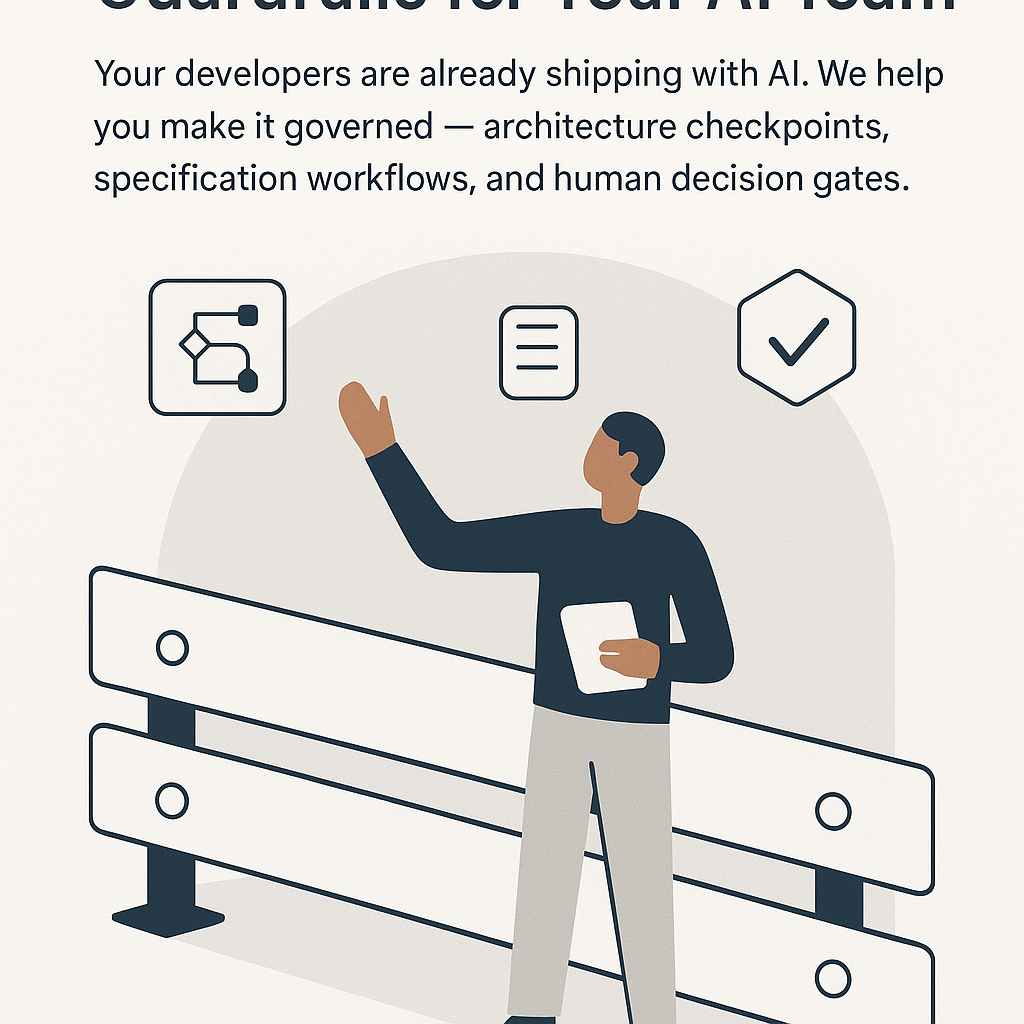
Your developers are already shipping with AI. We help you make it governed — architecture checkpoints, specification workflows, and human decision gates.
Fast output without accelerating technical debt.
Your developers are shipping with AI. Copilot, Cursor, Claude Code — the tools are in use and the output is coming fast. But fast output without governance is how you accumulate technical debt and unintended dependencies at an accelerated rate.
Guardrails for Your AI Team is a structured engagement that puts the right governance around your existing AI-assisted development — without slowing it down.
Three layers of governance, none of them bureaucracy.
Observation before prescription.
We start by observing how your team currently works. Not to judge the process, but to understand it. Where do agents get direction? Where are the implicit quality gates? What is working and what is not?
From that observation, we introduce the three layers. The goal is trained habits and documented practices your team can maintain — not a dependency on Consid.
A governance model that fits how your team already works.
- Governance assessment
An honest read on your current AI-assisted delivery process — what is working and what is quietly creating risk.
- Lightweight governance model
Implemented with your team, not handed over as a document. The three layers, fitted to your context.
- Trained habits and documented practices
Your team can maintain this after we leave. That is the goal.
- 30-day review session
We come back a month after implementation to assess what is working and what needs adjustment.
Teams shipping fast and starting to see the cost.
Engineering leads and CTOs whose teams are already using AI coding tools effectively but are starting to see the downstream costs: inconsistent architecture, difficult-to-review PRs, and technical decisions made by agents that should have been made by engineers.
Frequently asked
- What are guardrails in this context?
- Concrete controls — architectural constraints, specification gates, review checkpoints, and tooling policies — that let an AI-augmented team move fast without losing quality, security, or auditability.
- Do guardrails slow the team down?
- Well-designed guardrails increase sustained velocity. They remove ambiguity at decision points, so engineers and agents both spend less time re-litigating questions that should already be settled.
- How are guardrails enforced?
- A mix of specification, automation, and review gates. The goal is for the guardrails to be visible in the workflow, not bolted on as a separate compliance exercise.
Connected pages
- Read moreAssess your team with a development review
The assessment that surfaces which guardrails you actually need.
- Read moreRun delivery with Directed Agentic Delivery
The delivery model the guardrails are designed to support.
- Read moreRead about architecture-driven engineering
Why architecture is the primary guardrail in agentic delivery.
Tell us how your team is working. We'll show you where the gaps are.
A short conversation about your current delivery process is enough to scope the engagement.